
Dental fillings are dental treatments used to restore teeth that are decayed, eroded, worn, or cracked by placing a filling material to replace the missing tooth structure. This helps maintain the tooth’s original shape, prevents further destruction of tooth tissue, and allows normal function.
Who should get a filling
- People with tooth decay or visible holes on the tooth surface: If you notice black or brown spots on the tooth surface, feel a hole, or see unusually deep grooves—especially on the inner molars—leaving it untreated may allow the cavity to enlarge and progressively destroy more tooth structure.
- People with abnormal tooth sensitivity: Sharp sensitivity or sensitivity when eating hot, cold, or sweet foods, or even when air passes over the teeth, can indicate enamel damage reaching the dentin layer, making the nerves more responsive to stimuli.
- People who feel pain when chewing: Throbbing or sharp pain when using a tooth suspected of decay may suggest hidden decay under grooves or leakage from an old filling, which can transmit pressure toward the dental pulp.
- People who repeatedly get food stuck in the same area: If food frequently lodges in a certain spot and you often need to brush or floss to remove it, it may indicate decay on the side of the tooth that is not visible from above. In this case, a side filling may be needed.
- People with chipped, cracked, or broken teeth: Whether caused by an accident or accidentally biting something hard.
- People who have had fillings before: If the existing filling has started to discolor, crack, or fall out, the margins may no longer be smooth and can trap food and bacteria, increasing the risk of recurrent decay beneath the old filling.
Types of fillings
In general, fillings can be divided into two types based on the material used:
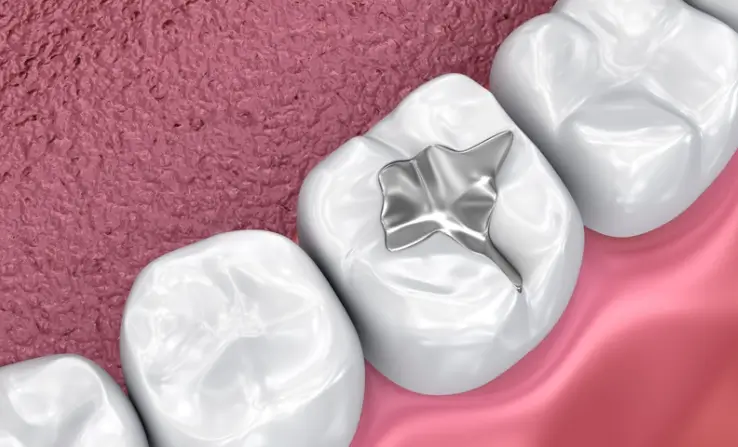
- Amalgam: Made from a mixture of silver, tin, and zinc. It is durable and strong, but because it is dark in color, it is not commonly used for front teeth. It is more suitable for molars. Advantages include high durability (often lasting for decades) and lower cost compared with other materials.
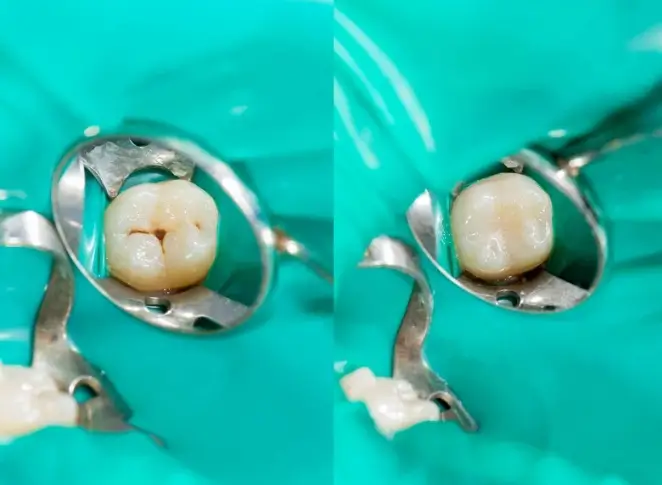
- Composite resin: Available in multiple shades to blend with natural teeth. It is commonly used for front teeth for aesthetics. It is widely used today because modern composite technology has strength close to amalgam. Disadvantages include a technique-sensitive process; saliva contamination should be avoided because it reduces effectiveness. It may cause temporary sensitivity after placement or lead to future leakage, and may require replacement if not done well. Its lifespan is about 5–10 years depending on size and location. Over time it may stain or change color, and it is slightly more expensive than amalgam.
- Glass ionomer: Releases fluoride, which helps prevent tooth decay. It is suitable for fillings in children or areas that do not receive heavy biting forces because it is less durable than composite or amalgam. It is often used for primary teeth, temporary fillings, root-surface fillings, or as a lining/base. It can also be tooth-colored.
- Ceramic/porcelain inlay-onlay: A newer restorative option with excellent aesthetics and high durability. The dentist prepares the cavity and takes an impression or uses a digital system to capture the shape of the area, then bonds the fabricated piece to the tooth. This provides high precision. It is highly resistant to fracture and wear, and its color does not change with foods and drinks, so it can look good for decades. Disadvantages include higher cost, greater complexity, and requiring at least two visits (impression/digital scan with a temporary filling, then placement of the final restoration).
- Other materials and new innovations: Such as fiber-reinforced composites for added strength in large cavities, ormocer materials (ceramic-modified polymers) that reduce shrinkage and improve gloss, and tooth-colored materials incorporating nano-ceramic particles to increase durability and reduce wear.
In summary, amalgam is considered a very cost-effective material because it has been used for a long time due to durability and the lowest cost. However, the silver color is very noticeable, so it is best for areas that are difficult to see and is not suitable for front teeth or for patients who prioritize aesthetics.
Which filling is best
Choosing the most suitable dental filling material depends on several factors, such as the tooth location, aesthetic expectations, cost, and the patient’s overall gum and oral health.
- Size and location of the cavity: If the cavity is in a highly visible area (e.g., front teeth), tooth-colored materials such as composite resin are usually preferred for better aesthetics.
- Budget: If the budget is limited, amalgam may be considered because it is generally less expensive.
- Patient preferences: If the patient prioritizes strength and durability, amalgam or composite resin may be appropriate choices.
| Material | Advantages | Disadvantages |
| Amalgam | Strong, durable, lower cost | Requires removing more tooth structure; color does not match natural teeth |
| Composite resin | Tooth-colored and aesthetic; suitable for both front and back teeth; modern composites can be nearly as strong as amalgam | Higher cost |
| Glass ionomer | Tooth-colored; can release fluoride | Not very strong or durable |
When you should get a filling
A filling is recommended when you experience the following:
- Tooth decay: You should get a filling when decay is present, which may be noticed through symptoms such as sensitivity to cold or hot foods, holes or cavities, tooth discoloration, loose teeth, or gum inflammation.
- Broken or chipped teeth: If a tooth is broken or chipped from an accident or daily use, a filling can restore the tooth’s shape and normal function.
- Replacing old fillings: If an old filling is worn, has fallen out, or has leakage that could lead to new decay, it should be replaced.
- Preparation for other dental treatments: In some cases, a filling may be needed to prepare for other procedures, such as a dental bridge.
Preparation before a filling
- Brush your teeth and rinse your mouth before treatment so the dentist can examine the teeth more easily.
- Inform the dentist about any medication allergies for safety.
- Schedule an appointment to assess gum and tooth health. If decay is severe and reaches the pulp, root canal treatment may be necessary.
- If you know you will receive an amalgam filling, eat beforehand because you must wait 24 hours before using that tooth.
- If you have removable dentures or a retainer, bring them so the dentist can check that they still fit after the filling.
- For children, treatment should be scheduled at least 2 hours after a meal to prevent vomiting.
Filling procedure: how it is done
- The dentist examines the teeth and evaluates whether a filling is an appropriate treatment.
- The dentist removes the decayed tooth structure, eliminating infected tissue before restoring the tooth with a filling material. Decayed tissue is typically soft, crumbly, and discolored. If the decay reaches the pulp, local anesthesia may be used to reduce pain.
- For tooth-colored fillings, composite resin is placed in layers and cured with an LED light to harden.
- For molar fillings, more tooth structure may be removed to ensure the filling material has adequate thickness; otherwise, thin remaining tooth structure may become a weak point and fracture easily.
- For interproximal (between-teeth) fillings, space must be maintained so floss can be used normally.
- After sufficient filling is placed, the dentist shapes and polishes it and adjusts the bite to be as close to normal as possible. The filling is not left too high, which could cause sensitivity or pain.
- The dentist cleans the tooth and provides aftercare instructions.
Benefits of fillings
- Restore damaged teeth so they can function normally.
- Prevent decay from progressing into deeper tooth layers and adjacent teeth.
- Reduce sensitivity to hot and cold temperatures that can cause tooth sensitivity.
- Improve the appearance of teeth that are cracked, broken, chipped, or decayed.
Drawbacks of fillings
- Some tooth structure must be removed.
- Temporary sensitivity may occur after the filling.
- Filling materials may not be as durable as natural teeth and may require replacement or repair after long-term use.
- If the filling is not done well, leakage may occur, allowing food debris to remain inside, promoting bacterial growth and leading to decay.
- Fillings are not suitable when a large amount of tooth structure has been lost, such as from an accident.
- Tooth-colored composite fillings can stain from foods.
Aftercare following a filling
- Teeth may be sensitive to temperature after the procedure; avoid very hot or very cold foods and drinks for 1–2 days.
- For the first 1–2 weeks, use the tooth gently and eat soft foods. If sensitivity is present, soft foods are especially recommended.
- Avoid biting or chewing hard foods for 24 hours to prevent the filling from cracking or coming out.
- Brush and floss daily to maintain oral health and reduce the chance of new decay around the filling.
- Do not whiten your teeth on your own yet, as this can increase sensitivity.
- Visit the dentist regularly every 6 months for checkups and scaling, including early detection and treatment of cavities.
Filling vs crown vs inlay: when to use each

When a filling is appropriate
A filling is the quickest and simplest treatment for early to moderate tooth decay. The dentist removes decayed tissue and replaces it with a filling material. A filling is recommended when:
- There is a small hole or dark spot and the decay has not progressed deeply.
- There is sensitivity to hot, cold, or sweet foods with a sharp sensation in that tooth, indicating decay.
- There is minor chipping or a small crack due to an accident.
- An old filling is cracked or leaking, which may cause decay beneath it.
When an inlay/onlay is appropriate
Inlays and onlays are restorations fabricated in a dental laboratory to fit the decayed or damaged area of a tooth and then bonded to the tooth. They are stronger, more durable, and more aesthetic than conventional fillings. An inlay replaces tooth structure within the grooves and does not cover cusps, while an onlay is larger and covers one or more cusps. Inlays/onlays are recommended when:
- The cavity is too large for a conventional filling; a standard filling may not withstand chewing forces and could fracture later.
- High strength and durability are needed, especially for molars that receive heavy chewing forces; ceramic or gold inlays/onlays are much stronger than typical filling materials.
- A molar has a crack or chip involving the cusps but enough healthy tooth remains so a full crown is not necessary.
- A precise fit and aesthetics are desired; lab-made restorations fit grooves well and closely match natural tooth color.
When a crown is necessary
A crown is like placing a helmet over the tooth, covering it entirely to protect the remaining structure from further fracture. A crown is recommended when:
- The tooth is severely fractured or damaged from an accident or biting something hard, with significant loss of tooth structure.
- The decay is extensive and too little healthy structure remains for a filling or an inlay/onlay.
- The tooth is heavily worn from grinding or frequent consumption of highly acidic foods.
- Tooth shape or color needs correction, such as abnormal tooth shape or severe discoloration that cannot be corrected by other methods.
- The tooth is used as an abutment for a bridge; crowns are placed on teeth adjacent to a gap to support a bridge.
- The tooth has undergone root canal treatment; root-canal-treated teeth are very brittle and prone to fracture, so a crown is necessary to protect the tooth.
Fillings for children
Caring for children’s primary teeth is important even though they will eventually fall out and be replaced by permanent teeth. If a child has tooth decay, they should be taken to a dentist to determine whether a filling is possible. Do not wait until the decay becomes severe, causes pain, or requires early extraction, because this can affect the development of incoming permanent teeth. The commonly used filling material for children is glass ionomer because it is quick and safe, releases fluoride to help prevent decay, and sets fast—suitable for children who may not cooperate well. If the tooth is the first permanent molar, composite resin may be selected for greater strength and better appearance.
For early-stage decay in children, fissure sealants or fluoride gel may be used to slow progression if the child has limited cooperation, with definitive treatment planned when the child is older.
Fillings for older adults
Older adults often experience enamel wear and gum recession, making root-surface decay more likely. Teeth that were previously filled may also deteriorate over time or develop leakage and recurrent decay. Dental evaluations every 6 months are recommended, with fillings or replacement when new decay is found under existing restorations. For older adults with multiple cavities or multiple cervical (neck of the tooth) lesions, glass ionomer is suitable because the procedure is simple and quick and it helps prevent further decay through fluoride release.
However, in areas that receive heavy force or in the front teeth, the dentist may use composite resin for strength and aesthetics, or use a base/liner material plus composite to combine fluoride benefits with strength. For molars with large recurrent cavities, a crown may be considered to prevent future fractures, because natural tooth structure becomes more brittle with age. Crowns or inlays can help distribute chewing forces and allow confident chewing without concern about further cracking (conventional fillings in teeth with significant structure loss may not last long and may be followed by fractures).
Fillings for people undergoing orthodontic treatment
For people with fixed braces who cannot remove the appliances themselves, if a cavity occurs the dentist will temporarily remove the wire and elastic modules from the tooth being treated, then place a tooth-colored composite filling and reattach the orthodontic components. If the cavity is close to the bracket, the bracket must be removed before drilling and filling, and then rebonded, which can increase overall orthodontic treatment time.
If decay reaches the pulp during orthodontic treatment, orthodontic treatment may need to be paused for root canal treatment or extraction of that tooth, followed by a revised orthodontic plan. Therefore, strict oral hygiene is recommended to reduce the risk of cavities.
Frequently asked questions about fillings
Can fillings be covered by Thailand’s Social Security benefits?
Fillings can be claimed under Social Security benefits. Insured persons under Sections 33 and 39 can claim dental expenses up to 900 baht per year without paying in advance (fillings, extractions, scaling, and wisdom tooth surgery are included). Note that the 900-baht limit is a combined annual cap for all covered dental procedures, not 900 baht per procedure. For example, if scaling costs 600 baht this year, 300 baht remains for fillings or extractions that year.
Do fillings hurt—do front-tooth fillings hurt?
Whether a filling is painful depends on several factors, such as the depth of decay, the location of the cavity, the condition of the tooth structure that must be removed, and the dentist’s experience.
Possible causes of pain after a filling include:
- The procedure itself, such as deep decay requiring local anesthesia; pain may come from the injection site and is not directly caused by the filling.
- Very deep decay close to the nerve; the closer it is to the nerve, the more discomfort and pain can occur.
- A very large restoration; replacing a large amount of natural tooth with restorative material can lead to flexing during chewing and cause sensitivity.
For these three causes, symptoms often gradually improve over about 10–14 days. If they do not improve, return to the dentist.
Can a severely decayed tooth be filled?
This depends on the depth of the decay. If decay has reached the pulp, a filling cannot be done; root canal treatment is required first.
Decay depth is divided into four levels:
Level 1: Decay is in the enamel surface; there is no destruction of the inner tooth layer.
Level 2: Decay penetrates into part of the outer dentin.
Level 3: Decay penetrates through the entire dentin.
Level 4: Decay reaches the pulp.
If decay is at Level 1 or 2, the dentist can place a filling after removing all decayed tissue, leaving enough sound tooth structure to retain the filling material.
If decay is at Level 3, the dentist may need to place a special strengthening material first, then place a conventional filling material on top.
If decay is at Level 4, a filling cannot be done because root canal treatment is required. Root canal treatment takes longer and is more expensive, and the dentist will determine whether root canal treatment is appropriate for that tooth.
Therefore, if a tooth begins to decay, it is recommended to see a dentist promptly for diagnosis and timely treatment to prevent progression into deeper layers. Sometimes decay appears minor on the outside, but has progressed internally without being visible to the patient.
If the tooth is not decayed and you want to prevent future cavities, a fissure sealant can be applied by coating the chewing surfaces with resin.
How long does a filling take?
In general, a filling takes about 30 minutes to 1 hour if the decay is not very deep and the area is easy to access.
If the decay is very deep or in a difficult-to-reach location, the dentist may need more time, such as 1 hour or longer.
In addition, tooth-colored fillings take longer because the material must be light-cured to harden.
How much does a filling cost?
| Service | Price (THB) |
| Dental filling (per surface) | 650 |
| Full-tooth restoration for a fractured tooth or large cavity | 3,500 |
| Temporary filling | 500 |
| Local anesthesia for filling or restoration | 200 |
Filling fees are calculated per surface. Each tooth has five surfaces.
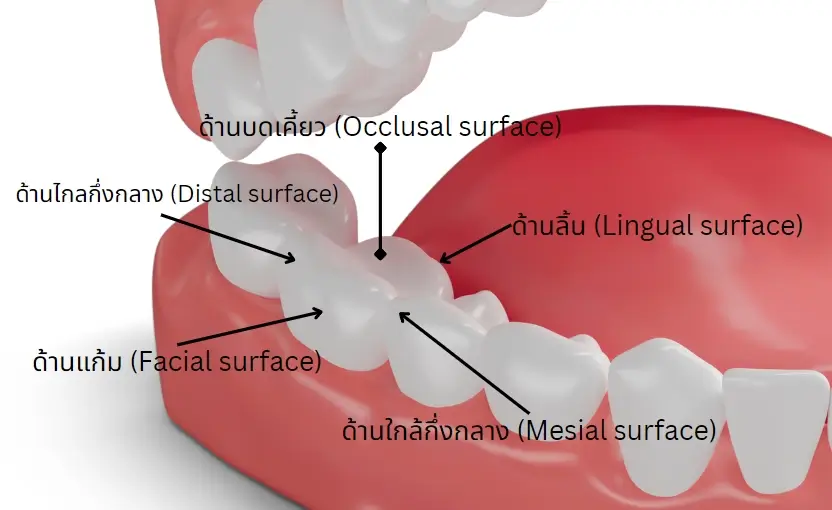
If decay is extensive—for example, involving three surfaces and each surface is very large—a filling may not be sufficient to restore tooth strength, and other methods may be needed.
What should you do if you have pain or sensitivity after a filling? Is it abnormal?
Pain after a filling can occur, especially when the decay is deep and close to the nerve; pain may be more severe. Patients can take pain relievers.
However, warning signs after a filling include:
- Toothache at night without a trigger, such as pain while resting.
- Pain when consuming warm or hot foods and drinks.
- Sensitivity to cold foods or drinks that continues for minutes even after the stimulus is removed.
These symptoms suggest the nerve may have been significantly affected, and root canal treatment or other dental treatment may be needed. If these symptoms occur, you should return to the dentist promptly because symptoms can worsen if left untreated, such as developing pus at the root tip and possibly requiring extraction.
How long do filling materials last?
This depends on the material used:
- Amalgam: Average lifespan 10–15 years (or longer)
- Composite resin: Average lifespan 5–10 years
- Glass ionomer: About 5 years or less
- Gold inlay/onlay: 15–30+ years (most durable)
- Porcelain/ceramic inlay/onlay: 10–20 years
