Orthodontics is a dental treatment used to correct the alignment of the teeth and bite. It helps improve problems such as crowded teeth, protruding teeth, buck teeth, gaps between teeth, an improper bite, and even protruding jaws, so that the teeth can be aligned properly, meet correctly when biting, and become easier to clean. It also helps improve confidence by creating a neat and attractive smile.
What Types of Teeth Problems Should Be Treated with Braces?
Teeth that should be treated orthodontically are any teeth with abnormal alignment that make oral hygiene difficult or interfere with chewing. These include:
- Crowded or crooked teeth: These are harder to clean because some teeth overlap or sit behind others, making the back surfaces difficult to reach and increasing the risk of tooth decay.
- Protruding teeth / buck teeth: These can cause bite problems, make chewing inconvenient, and may affect speech clarity.
- Deep bite: The upper front teeth excessively overlap the lower front teeth. In severe cases, the lower front teeth may hit the gums behind the upper teeth, causing wounds, tooth sensitivity, and gum problems.
- Open bite: The upper and lower front teeth do not touch when biting, making it difficult to bite through food properly, such as noodles. When smiling, it may look as if the mouth is slightly open, which can affect confidence.
- Lower teeth overlapping upper teeth: A dentist must first assess the cause. If it is due to tooth position, braces may correct it. If it is due to jaw abnormalities, jaw surgery may also be required.
- Midline deviation / uneven bite: When biting down, the centerline of the upper and lower teeth does not match, which can make chewing difficult.
- Gapped teeth: This can affect confidence and pronunciation, and the gaps can trap food easily, increasing the risk of cavities.
- Crossbite: When biting down, the upper teeth bite inside or across the lower teeth, which can cause the upper teeth to rub against the inner cheek. In severe cases, it may also be associated with facial asymmetry.
In addition, if a jaw-related abnormality is found, treatment should begin at a young age so it is easier to correct. If there is a problem with certain tooth positions, it should also be treated early, because leaving it untreated may affect jaw development and the adjacent teeth. Certain habits can also influence the development of the jaw and teeth, such as frequent thumb sucking, mouth breathing, and abnormal swallowing.
How to Prepare Before Getting Braces
Before starting orthodontic treatment, the dentist will examine your oral health, teeth, and jawbone to make sure everything is ready. They will check whether you have cavities, teeth that need fillings, whether you need scaling, or whether gum disease needs to be treated first. These steps are known as pre-orthodontic oral preparation.
X-rays
X-rays are taken to assess the position of the teeth and bone, the bite relationship between the upper and lower teeth, the relationship between the jaws and teeth, and other structures that cannot be seen with the naked eye.
Digital iTero Scan
This is a modern way of taking dental impressions, commonly used for clear aligner treatment. An iTero scan helps plan treatment very effectively because it allows patients to preview the expected results even before treatment begins.
Dental Impressions
This is the traditional method of taking impressions, where the patient bites into impression material to create a model of the teeth. This allows the dentist to evaluate the size, position, and characteristics of the teeth.
Tooth Extraction
If the patient has severe crowding or too many teeth in a limited space, tooth extraction may be necessary to create more room and allow the teeth to move more easily.
Jaw Surgery
If the patient’s problem is caused by the jaw and braces alone cannot solve it, jaw surgery may be required in combination with orthodontic treatment.
Once all the preparation steps are completed, the orthodontic process can begin.
How Many Types of Orthodontic Treatment Are There?
Orthodontic treatment can mainly be divided into 4 major types, as follows:
Metal Braces

Metal braces, also known as traditional braces with colored bands, are the most common type and can be seen everywhere. They are especially popular among teenagers because they are more affordable. This type uses silver-colored brackets that are fixed onto the teeth and works together with O-rings, which hold the archwire onto the brackets so the wire can move the teeth into the desired position.
Advantages of metal braces
- Affordable
- Can treat all forms of crowding and crooked teeth
- Food debris and plaque tend to stick less compared with some other materials
- Patients can choose different colors for the elastic bands
Disadvantages of metal braces
- There is usually tightness or soreness each time the wire is changed, and it may take 2–3 days to adjust
- Teeth are harder to clean than usual
- Monthly dental visits are required for adjustments and O-ring changes
Ceramic Braces

Ceramic braces use tooth-colored ceramic brackets attached to the front surface of the teeth. Like metal braces, an archwire runs through the brackets, and clear O-rings are used to hold the wire in place and move the teeth in the desired direction.
Advantages of ceramic braces
- The brackets are similar in color to natural teeth, so they are less noticeable
- Suitable for people who want braces but do not want them to be very obvious
- Suitable for patients with metal allergies who cannot use metal braces
- Less visible food debris compared with metal braces
Limitations of ceramic braces
- More expensive than metal braces
- The brackets are more fragile than metal ones
- Monthly adjustment visits are still required, and treatment usually takes 2 years or more
Damon Braces

Damon braces use a special type of bracket called a Damon bracket. Unlike the two types above, Damon braces do not require O-rings. They are highly efficient and use a small sliding mechanism to help move the teeth into shape.
Advantages of Damon braces
- No problems with O-rings breaking or deteriorating, since O-rings are not used
- Shorter treatment time due to reduced friction from the sliding mechanism
- Less discomfort during treatment because there are no elastic ties
- Easier to keep clean, reducing the risk of cavities and gum inflammation
There are 2 main types of Damon braces:
- Damon Q – metal type
- Damon Clear – clear type
Limitations of Damon braces
The cost is relatively high, and tartar can build up more easily.
Lingual Braces
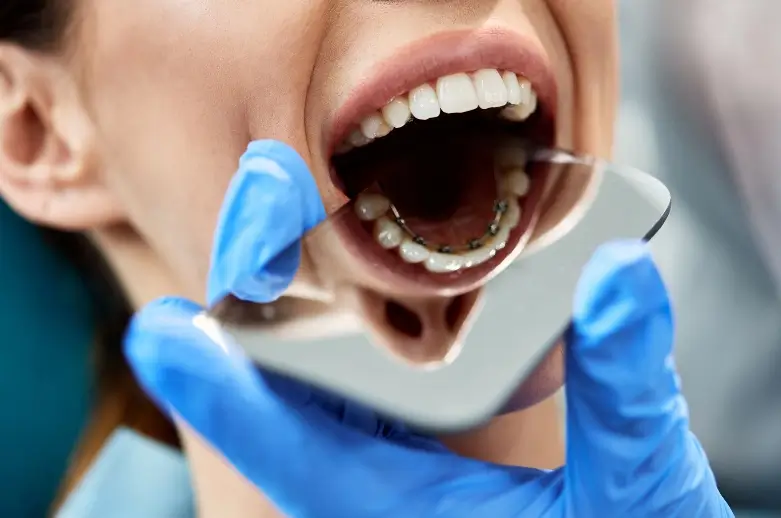
Lingual braces are attached to the back surfaces of the teeth instead of the front, making them invisible from the outside. The main advantage is that they meet the needs of patients who want orthodontic treatment without visible braces. However, the limitation is that they are more difficult for the dentist to work with because there is much less space behind the teeth than in front.
Clear Aligners

Clear aligners are a relatively new form of orthodontic treatment compared with other types and originated in the United States. This option focuses heavily on aesthetics because the aligners are transparent and difficult to notice. They can be removed and reinserted by the patient, and patients can eat normally without worrying about food getting stuck in metal brackets and wires.
This type of orthodontic treatment is popular among actors, singers, and public figures because it is difficult to tell that they are undergoing treatment, helping them maintain their appearance and confidence. Treatment time usually ranges from 6 months to 2 years.
A popular clear aligner brand is Invisalign, which MOS offers in 5 package types:
- Invisalign Go – for front teeth only
- Invisalign Express or Invisalign i7 – for minor corrections
- Invisalign Lite – for moderately difficult cases
- Invisalign Essential – for shorter treatment cases, around 1–2 years
- Invisalign Full or Invisalign Comprehensive – the highest package, suitable for difficult or highly detailed cases, with an unlimited number of aligners and treatment coverage for up to 5 years
Steps in Orthodontic Treatment
The exact steps may vary depending on the type of treatment, but in general, the process is similar:
- Visit a specialist orthodontist for diagnosis, so the treatment plan matches your facial structure, jaw, and teeth. The dentist will also ask about medical conditions or drug allergies and discuss treatment options with you to decide which type of braces is most suitable.
- Have your oral health checked to make sure your teeth and gums are healthy, or determine whether any issues need to be treated first. After that, dental impressions are taken to study the tooth structure and bite, along with X-rays to evaluate the jaw and look for abnormalities.
- The patient and dentist discuss which type of orthodontic treatment to choose, including the approximate cost.
- The dentist treats any other oral health problems first, such as scaling, fillings, or extractions, before fitting the braces.
- The agreed orthodontic appliance is fitted.
- After wearing the braces for some time, the patient must return for scheduled follow-up appointments to monitor progress.
- The braces are removed, and the patient is given a retainer to maintain the teeth in their new position and prevent them from shifting back. The dentist will assess and advise how long the retainer should be worn.
How Should You Prepare Before Getting Braces?
Before starting orthodontic treatment, the first thing you should do is choose a specialist orthodontist. It is also important to understand that orthodontic treatment usually takes around 2 years. During this period, you will need to attend regular appointments to monitor your dental health. Therefore, you should plan ahead and make sure you will be able to attend your appointments consistently, for example, if you are not planning to move overseas for study during that time.
You should also have your oral health checked first, because each person’s treatment plan may be different depending on their facial structure and dental condition. Some people may need extractions before starting orthodontic treatment, while others may not.
How to Care for Your Teeth After Getting Braces
After orthodontic treatment, proper care is essential to maintain long-lasting results. Recommended care includes:
- Brush your teeth properly: After getting braces, food can get trapped around the appliance, increasing the risk of plaque and enamel damage. You should brush carefully using a toothbrush designed for orthodontic patients and use dental floss to clean between the teeth and around the braces thoroughly.
- Attend all follow-up appointments: Your dentist will check both your teeth and the orthodontic appliance and address any issues that may arise.
- Choose appropriate foods: Avoid very hard or sticky foods such as raw carrots, hard bread, chewing ice, or chewy snacks that could damage the braces. You should also avoid foods high in sugar to reduce the risk of cavities.
- Use mouthwash or rinse with salt water after brushing: This helps reduce bacteria in the mouth and reach areas that a toothbrush may not clean effectively.
- Wear your retainer as instructed: Retainers help maintain the position of your teeth after the braces are removed. They should be worn exactly as directed by your dentist to prevent the teeth from shifting back.
Advantages of Orthodontic Treatment
- Improves the appearance of the teeth by correcting spacing, crowding, crookedness, and imbalanced tooth positions
- Helps the teeth bite together properly and improves chewing efficiency
- Reduces the risk of gum disease and tooth decay because the teeth are easier to clean
- Helps improve speech clarity, since properly positioned teeth support more accurate pronunciation
- Boosts self-confidence by creating a straighter smile, making you feel more comfortable smiling, communicating, and interacting with others
- Provides long-lasting results and is a worthwhile investment for long-term oral health
Disadvantages of Orthodontic Treatment
- It takes a long time; in some cases, treatment may take several years depending on the complexity and the type of braces used
- The overall cost can be quite high because treatment continues over a long period
- There may be discomfort, soreness, or tightness, especially at the beginning
- Ongoing care is required throughout the treatment period, and regular dental visits are necessary
- Certain hard or sticky foods must be avoided to prevent damage to the braces
- Gum problems or cavities may occur if oral hygiene is not maintained properly
Where Is a Good Place to Get Braces?
Mos Dental Clinic would like to be one of your options for orthodontic treatment. We have 32 branches, serve more than 250,000 patients per year, and have over 400 experienced dental professionals. This allows you to feel confident that you will receive quality care from highly experienced dentists who can design a treatment plan that suits each individual patient appropriately.
How Much Does Orthodontic Treatment Cost?
| Type of Orthodontic Treatment | Price (THB) |
| Metal Braces | 40,000-50,000 |
| Damon Braces | 59,000-80,000 |
| Clear Aligners – Invisalign Essentials | 70,000-95,000 |
| Clear Aligners – Invisalign Full Comprehensive | 150,000 |
| Clear Aligners – Invisalign Go | 59,000 |
| Clear Aligners for Children – Invisalign First | 59,000 |
Note: The prices and treatment durations listed above are preliminary estimates only. The actual cost may vary depending on the patient’s oral condition, the dentist’s treatment plan, and any clinic promotions available at that time.
